
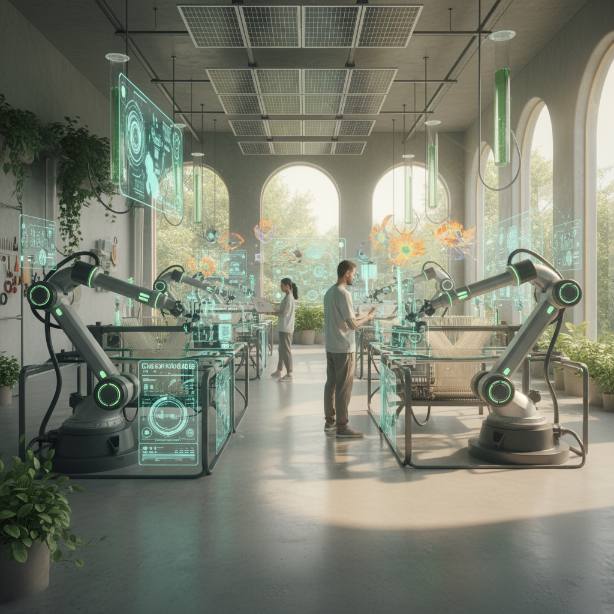
Introduction: Designing Sustainability Into the First Sketch
As industries intensify their sustainability commitments, eco-design has become more than a trend—it is a strategic imperative. Traditional approaches often address environmental impact after a product is designed, leaving limited room to reduce emissions, material waste, or energy consumption.
Today, Artificial Intelligence is redefining eco-design, enabling designers and engineers to make environmentally responsible decisions from the very beginning of the creative process. By combining AI-driven insights with human intuition, companies and independent creators can dramatically reduce impact while maintaining creativity, functionality, and aesthetic quality.
AI does not replace eco-design principles—it supercharges them.
What Is Eco-Design Enhanced by AI?
Eco-design aims to minimize environmental impact throughout a product’s life cycle by considering sustainability during concept development, material selection, production, use, and end-of-life management.
AI adds a powerful new dimension by providing:
- Real-time environmental assessments
- Predictive performance analysis
- Automated optimization
- Data-driven insights for sustainable choices
- Simulation tools that anticipate a design’s long-term footprint
This transforms eco-design from a manual, expertise-heavy process into a scalable, accessible practice for designers at all levels.
AI-Driven Strategies to Reduce Environmental Impact from the Start
1. Material Optimization Guided by Data
Choosing the right material is one of the most impactful decisions in eco-design. AI tools now analyze:
- Carbon footprint per kilogram
- Recyclability and circularity potential
- Mechanical resistance and durability
- Extraction and processing impact
- Supply chain emissions
Designers can instantly compare alternatives and prioritize sustainable materials without compromising performance.
AI enables:
- Replacing high-impact materials with greener equivalents
- Suggesting recycled or bio-based options
- Predicting long-term wear, degradation, or environmental interactions
This reduces waste upstream and increases product longevity.
2. AI-Accelerated Lifecycle Analysis (LCA)
Lifecycle analysis traditionally requires time, specialized knowledge, and extensive manual data input. AI automates much of this process by:
- Pulling data from vast material and industry databases
- Estimating environmental impact in seconds
- Simulating multiple product lifecycles
- Highlighting “hotspots” of waste or emissions
This gives designers immediate feedback about the environmental performance of their concepts—before any prototype is made.
3. Generative Design for Energy and Material Efficiency
AI-powered generative design uses algorithms to create thousands of variations based on constraints such as:
- Material reduction
- Structural performance
- Recyclability
- Modularity
- Manufacturing methods
These designs often take the form of lightweight, organic structures that use up to 30–70% less material—a massive reduction in environmental impact.
This strategy is particularly effective for:
- Furniture and interior design
- Automotive and aerospace components
- Consumer products
- Jewelry and artistic objects
- Architecture and structural systems
Generative design merges sustainability and innovation seamlessly.
4. Predictive Modeling to Reduce Prototyping Waste
Physical prototyping consumes materials, energy, and time. AI reduces this waste through simulation and predictive modeling by:
- Testing structural behavior
- Predicting thermal or mechanical responses
- Identifying weak points
- Evaluating long-term usage impact
Predictive models allow designers to validate ideas digitally and reduce the number of physical prototypes needed.
This significantly cuts down:
- Material consumption
- Production energy
- Transport and logistics emissions
- Development time
5. Intelligent Design for Disassembly and Circularity
AI supports circular eco-design by recommending strategies for end-of-life impact reduction, such as:
- Modular assemblies
- Easily separable materials
- Zero-waste joint strategies
- Repair-friendly structures
- Designs that support recycling loops
AI can evaluate how a product will be disassembled decades later, ensuring its materials remain valuable.
This transforms products into resources rather than waste.
AI Supporting Sustainable Manufacturing Methods
1. Optimizing for Low-Impact Processes
AI suggests the most sustainable production methods by evaluating:
- Manufacturing energy requirements
- Machine usage patterns
- Waste generation
- Water consumption
- Process emissions
This aligns eco-design with eco-manufacturing for a coherent, sustainable workflow.
2. Enabling On-Demand and Local Production
AI forecasting tools help predict demand, reducing overproduction and enabling more sustainable, localized manufacturing.
This minimizes:
- Stock waste
- Storage energy
- Transportation emissions
Human Creativity at the Heart of AI-Enhanced Eco-Design
While AI provides insights and optimization, the essence of eco-design remains deeply human.
1. Designers Define Values and Intent
AI suggests possibilities, but humans decide what matters:
- Aesthetic direction
- Ethical considerations
- Functionality
- Cultural relevance
2. The Designer Becomes a Sustainability Strategist
With AI handling calculations and simulations, designers focus on:
- Purpose-driven design
- Material storytelling
- Long-term ecological impact
- User-centered solutions
- Emotional and cultural resonance
AI supports creativity, but does not dictate it.
Challenges and Considerations
1. Data Quality Matters
Eco-design depends on accurate data. AI models must be fed transparent, reliable databases.
2. Avoiding “Greenwashed” Automation
Automation must be paired with ethical intent—not used to justify superficial sustainability claims.
3. Skills Development
Designers must learn to interpret AI insights and integrate them meaningfully into the creative process.
Conclusion: AI as a Catalyst for Responsible Creation
AI-enhanced eco-design marks a profound shift in how we create products, buildings, and experiences. By integrating sustainability from the very first sketch, designers can reduce environmental impact dramatically—without compromising innovation or artistic identity.
The future of sustainable design is collaborative, where human creativity and AI intelligence work hand-in-hand to imagine responsible, beautiful, and long-lasting solutions.
When used with purpose and intention, AI becomes a transformative ally—empowering designers to shape a world where creativity and sustainability evolve together.