Introduction: Beyond Automation Toward Human-Centered Innovation
For decades, industrial innovation has been defined by automation. Industry 3.0 introduced digital systems, and Industry 4.0 revolutionized factories with robotics, IoT, and data-driven optimization. But as automation grew, so did concerns about dehumanization—workforces felt displaced, creativity was undervalued, and technological efficiency sometimes overshadowed human expertise.
Enter Industry 5.0, a new paradigm that bridges advanced technology with human values. Instead of simply maximizing productivity, Industry 5.0 emphasizes human–machine collaboration, personalization, sustainability, and resilience. It brings people back to the center of production, harnessing technology to enhance—not replace—their capabilities.
What Is Industry 5.0?
Industry 5.0 is a human-centric evolution of modern manufacturing. While Industry 4.0 focused on cyber-physical systems and digitized automation, Industry 5.0 aims to create environments where humans and machines complement each other.
Core Principles of Industry 5.0
- Human-centricity: Technology adapts to humans, not the other way around.
- Sustainability: Processes minimize waste, energy consumption, and environmental impact.
- Resilience: Systems are flexible, adaptive, and prepared for disruptions.
- Customization & craftsmanship at scale: Personalization becomes feasible without sacrificing efficiency.
In this model, robotics, AI, and advanced manufacturing empower human skills—creativity, intuition, problem-solving—to thrive.
Why Industry 5.0 Matters: A Human Response to Automation
As Industry 4.0 automated repetitive and predictable tasks, new challenges emerged:
- Loss of human touch in production
- Skills gaps and workforce displacement
- Overreliance on rigid automated systems
- Sustainability concerns
- Reduced emotional connection to manufactured products
Industry 5.0 responds by creating collaborative value, where automation enhances human creativity and decision-making rather than replacing them.
Human–Machine Collaboration: The Core of Industry 5.0
1. Collaborative Robots (Cobots)
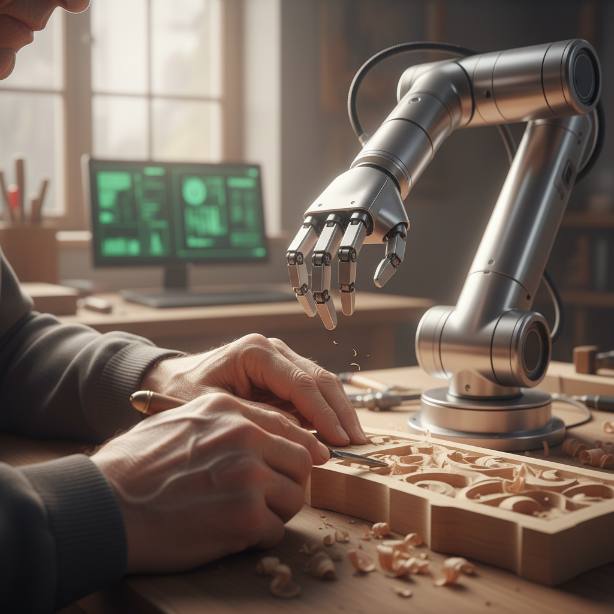
Cobots are designed to work safely alongside humans. They do not replace craftsmanship but assist by:
- Handling repetitive or hazardous tasks
- Improving ergonomics
- Increasing accuracy and consistency
- Allowing humans to focus on high-value creative processes
Cobots support a more humane, productive, and stimulating workspace.
2. AI-Enhanced Human Decision-Making
AI systems help workers make better decisions by:
- Predicting maintenance needs
- Optimizing design and engineering parameters
- Recommending workflow improvements
- Simulating complex scenarios
Instead of removing autonomy, AI amplifies human intelligence.
3. Augmented Reality and Wearable Tech
AR and wearable devices empower workers by providing:
- Real-time instructions
- Digital overlays for complex assembly tasks
- Hands-free information access
- Enhanced safety monitoring
This reduces errors and shortens learning curves.
Customization and Human Creativity at Scale
Industry 5.0 enables companies to achieve mass customization—once impossible in traditional factories. Thanks to AI, digital twins, and advanced robotics, manufacturers can adapt products to individual needs without slowing production.
This opens new opportunities in:
- Luxury goods: Personalized jewelry, watches, accessories
- Healthcare: Custom implants, prosthetics, and medical devices
- Furniture and interior design: Tailor-made components
- Automotive: User-specific seat shapes, control configurations
- Fashion: Adaptive garments and individualized sizing
By reintroducing human creativity into automated workflows, industries can combine craftsmanship with industrial precision.
Sustainability as a Driving Force
Industry 5.0 pushes companies to adopt greener production strategies by enabling:
- On-demand manufacturing that reduces waste
- AI-guided energy optimization
- Localized production, decreasing transportation emissions
- Circular materials through advanced recycling systems
- Design for disassembly and repairability
Through smart collaboration, human insight and machine intelligence combine to create more responsible and resource-efficient industrial ecosystems.
Resilience: A Future-Proof Production Model
Recent global events demonstrated the fragility of highly automated supply chains. Industry 5.0 enhances resilience by introducing:
- Flexible manufacturing cells
- Distributed production networks
- Workers empowered to make real-time decisions
- Systems that adapt quickly to disruptions
Human adaptability remains unmatched, and when supported by intelligent machines, organizations become far more resilient.
Impact on the Workforce: Upgrading Skills, Not Eliminating Jobs
Rather than replacing workers, Industry 5.0 transforms their roles.
New Skills and Opportunities
Workers transition from performing repetitive manual tasks to:
- Supervising cobots
- Operating advanced machines
- Managing data and digital workflows
- Engaging in creative design processes
- Performing high-value craftsmanship
A More Meaningful Work Environment
Industry 5.0 advocates for:
- Safer working conditions
- Reduced physical strain
- Higher creativity and autonomy
- Opportunities for lifelong learning
This leads to more fulfilling careers and motivates talent to remain in manufacturing sectors.
Examples of Human–Machine Synergy Across Industries
Luxury & Design
Artisans use AI-generated forms and precision robotics to craft unique, high-end products.
Healthcare
Surgeons collaborate with AI and robotic systems for precise operations and personalized medical devices.
Manufacturing & Engineering
Engineers co-create with AI to generate optimized parts impossible to design manually.
Art & Craftsmanship
Creators combine digital fabrication with hand-finishing to produce hybrid masterpieces.
Conclusion: Rehumanizing the Future of Industry
Industry 5.0 is not just the next technological revolution—it’s a cultural shift that places humans back at the center of production. By fostering a collaborative environment where machines amplify human potential, this new industrial model offers sustainable growth, greater creativity, and meaningful workforce empowerment.
The future of industry is not fully automated. It is collaborative, resilient, personalized, and deeply human—where advanced technology and human creativity work together to build a better, more sustainable world.