

The poultry industry has long grappled with the challenge of accurately determining the sex of chicks, a process crucial for ensuring optimal health and production standards in flocks.
Traditional manual techniques, though widely practiced, face criticisms regarding their effectiveness and efficiency. Enter Genesys, a modern marvel that promises precision and consistency in the sexing process. In our exploration today, we’ll dive into the nuances between these methods, highlighting key differences and the potential benefits of adopting new technologies.
Whether you are a scholar, a vet, or simply someone curious about avian production, join us as we unfold the layers of these intriguing processes.
Unpacking Traditional Sexing Methods
Traditionally, the poultry industry has relied on manual sexing techniques, a method that involves discerning the sex of chicks by examining feather patterns or other subtle physical factors. While this practice has been in place for decades, it comes with its own set of challenges.
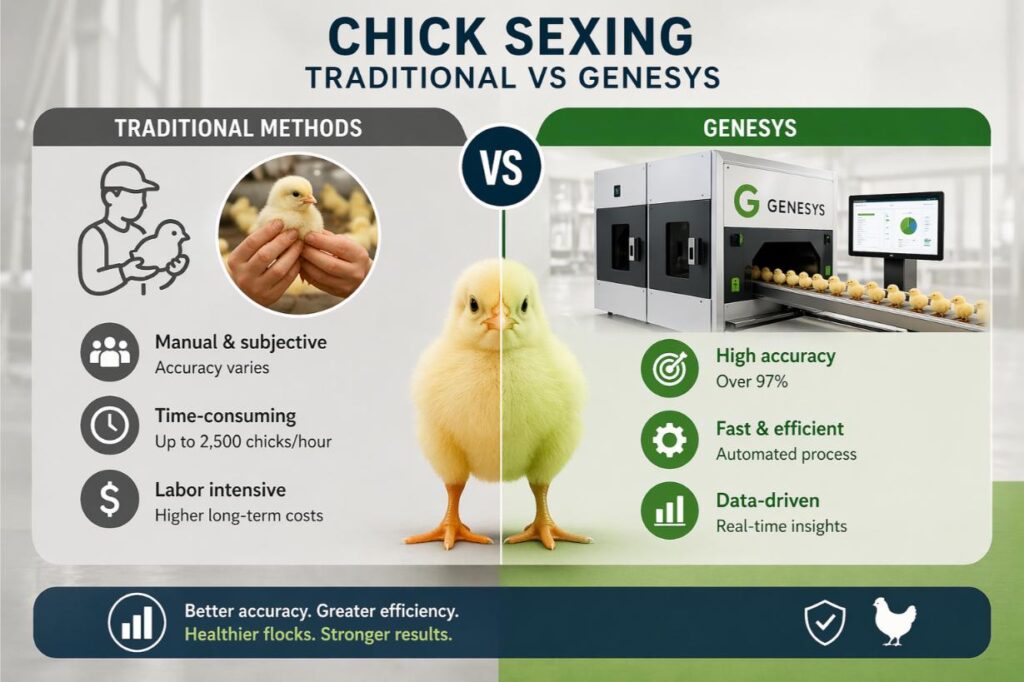
One of the primary limitations of manual sexing is its dependency on human operators. This reliance can introduce a degree of subjectivity, leading to variations in accuracy. Studies have reported that the precision of manual sexing can fluctuate significantly, impacting the health and suitability of the flock for sale. Additionally, the process is time-consuming; handlers typically manage upwards of 2,500 chicks per hour, a feat that demands physical stamina and sharp attention.
The labor-intensive nature of manual sexing also places a strain on industries facing manpower shortages. In large-scale operations where millions of chicks need to be sorted weekly, maintaining a consistent workforce becomes increasingly challenging. This often results in higher operational costs and potential delays in production schedules.
Despite these limitations, manual sexing still holds value due to its reatively low setup costs. The technique requires minimal machinery, making it a feasible choice for smaller operations. However, as theindustry leans towards more modern and reliable solutions, it’s evident that manual methods may soon become obsolete.
The Rise of Genetics: Genesys in Focus
The introduction of Genesys represents a significant leap forward in the field of poultry sexing. This cutting-edge technology employs genetic algorithms to ascertain the sex of chicks with unprecedented accuracy.
Genesys stands out for its precision, regularly achieving a consistent accuracy rate of over 97%. This high level of accuracy minimizes the risk of mislabeling, ensuring that flocks are optimally organized according to the needs of the market.
For instance, some markets might demand higher proportions of males for meat production, while others may prefer females for laying purposes. By using a system like Genesys, producers can better meet these demands, thereby potentially increasing profitability.
Beyond accuracy, the Genesys system offers a streamlined design. Its modular and compact structure allows it to fit seamlessly into existing operations, requiring as little as 5 square meters per module. Furthermore, the system is designed for scalability, allowing producers to expand operations without significant infrastructural changes.
Another notable feature is its capacity for remote supervision. This not only facilitates proactive performance monitoring but also enables efficient troubleshooting. Advanced data management capabilities make Genesys an invaluable tool for producers keen on optimizing their operations. Real-time access to performance indicators and flock data aids in making informed decisions that can impact overall health and productivity.
Weighing the Pros and Cons
When considering the transition from traditional sexing methods to Genesys, it’s crucial to weigh the advantages and potential drawbacks.
Pros of Traditional Methods:
- Cost-Effective Start-Up: No need for expensive machinery.
- Simplicity: Basic training enables staff to perform sexing without technological reliance.
Cons of Traditional Methods:
- Inconsistent Accuracy: Human error impacts results.
- Labor Intensive: High manpower demand can lead to increased costs.
Pros of Genesys:
- High Precision: Over 97% accuracy ensures reliable flock categorization.
- Efficiency: Automated process reduces time and labor.
- Scalability: Flexible design allows for easy integration and expansion.
- Data Management: Real-time data enhances operational decision-making.
Cons of Genesys:
- Initial Investment: Higher upfront cost compared to manual methods.
- Maintenance Needs: Continuous supervision and system maintenance required.
While the choice between the two methods depends on individual operation needs, it’s evident that the benefits of Genesys often outweigh the initial investment challenges. As health standards and market demands evolve, the inclination towards modern solutions is likely to grow.
In the dynamic world of poultry production, the sexing of chicks is a critical factor that can dictate the success of an operation. Traditional methods, while familiar and cost-effective, struggle to keep up with modern demands for accuracy and efficiency.
On the other hand, Genesys brings forth a technological revolution that promises not only accuracy but also operational flexibility and data-driven insights.
Ultimately, the decision to transition from traditional techniques to advanced systems like Genesys depends on various elements including health priorities, market demands, and economic factors. However, with the ability to access real-time data and ensure consistent sorting precision, Genesys appears as a compelling choice for forward-thinking producers eager to align with the future of poultry production.
In this era of innovation, embracing such technological advancements isn’t just about staying competitive : it’s about setting new standards and paving the way for a healthier, more productive future in poultry production.